




Antigen is the AI adversary that maps, exploits, and secures your entire attack surface.

Vulnerabilities
OpenExploit reproduced by Antigen
2
ANT-004
Unsigned webhook endpoint accepts forged integration events
TriagingInspecting the endpoint
ANT-018
GraphQL introspection exposes internal service schema
TriagingInspecting the endpoint
In ProgressFix opened for your review
2
ANT-021
CI workflow exposes organization token
Ready for review
ANT-005
Over-scoped automation tokens in CI environment
RemediatingDrafting IAM policy change
RemediatedMerged, re-running original exploit
1
ANT-014
Cross-tenant report access via workspace header mismatch
VerifyingReplaying the original exploit
VerifiedOriginal exploit no longer works
2
ANT-006
Billing route isolation across tenant boundary
Exploit no longer reproduces
ANT-011
Workspace removal leaves active sessions valid
Exploit no longer reproduces
Accepted RiskDeliberately deferred
0

Anyone can hack now.
AI can now find and exploit vulnerabilities on its own.

Meet tCell, our offensive agent.
It runs the same attacks on your infrastructure, first.

Chains exploits into working attacks

tCell links weaknesses the way an attacker would. One small gap opens the path to the next, until it reaches something that matters. Scanners see the pieces; tCell finds the route.

Probes your systems like an attacker

tCell signs into accounts, moves between them, and maps your full attack surface. It hunts for cross-tenant leaks, broken isolation, and misconfigured access. It tests like someone with intent would and not like a checklist.

Finds what point-in-time audits miss

tCell routinely finds vulnerability missed by years of point-in-time audits. Your engineering team ships new changes daily; tCell keeps up where ordinary pentests don't.

Security at the speed you ship.

Point-in-time testing and continuous testing

Point-in-time pentesting

Vulnerabilities frozen at audit time.

  • Weeks of setup before testing begins.
  • You receive a PDF report 2 weeks later
  • Patching is your team's problem
  • Fixes are tested again 6-12 months later

Continuous pentesting

Probes your systems like an attacker

  • Easy setup and onboarding
  • Findings show up on the board in real time, as they're found.
  • Antigen opens PRs, your engineers review and merge.
  • Every fix is immediately retested end-to-end.

Find, fix, verify

The lifecycle of a vulnerability

01.

Discover vulnerabilities

Every finding comes with a working exploit

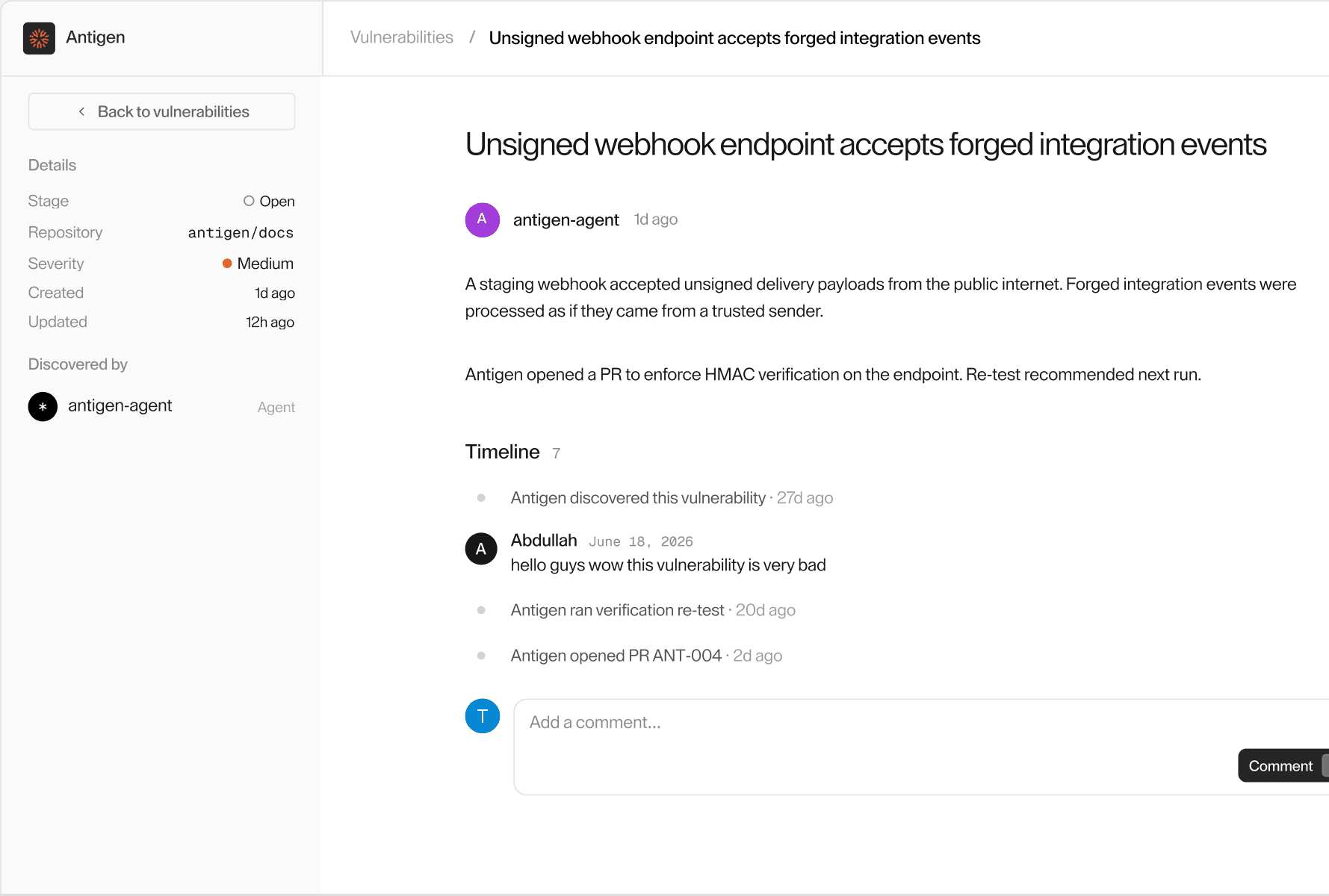
Antigen probes your live attack surface the way an attacker would, chaining weaknesses traditional security scanners report in isolation into paths that actually reach sensitive data.

Every finding arrives with a reproducible exploit attached, so instead of a backlog of hypothetical CVEs, you start with confirmed, exploitable routes.
02.

Remediation and review

Antigen makes your team faster

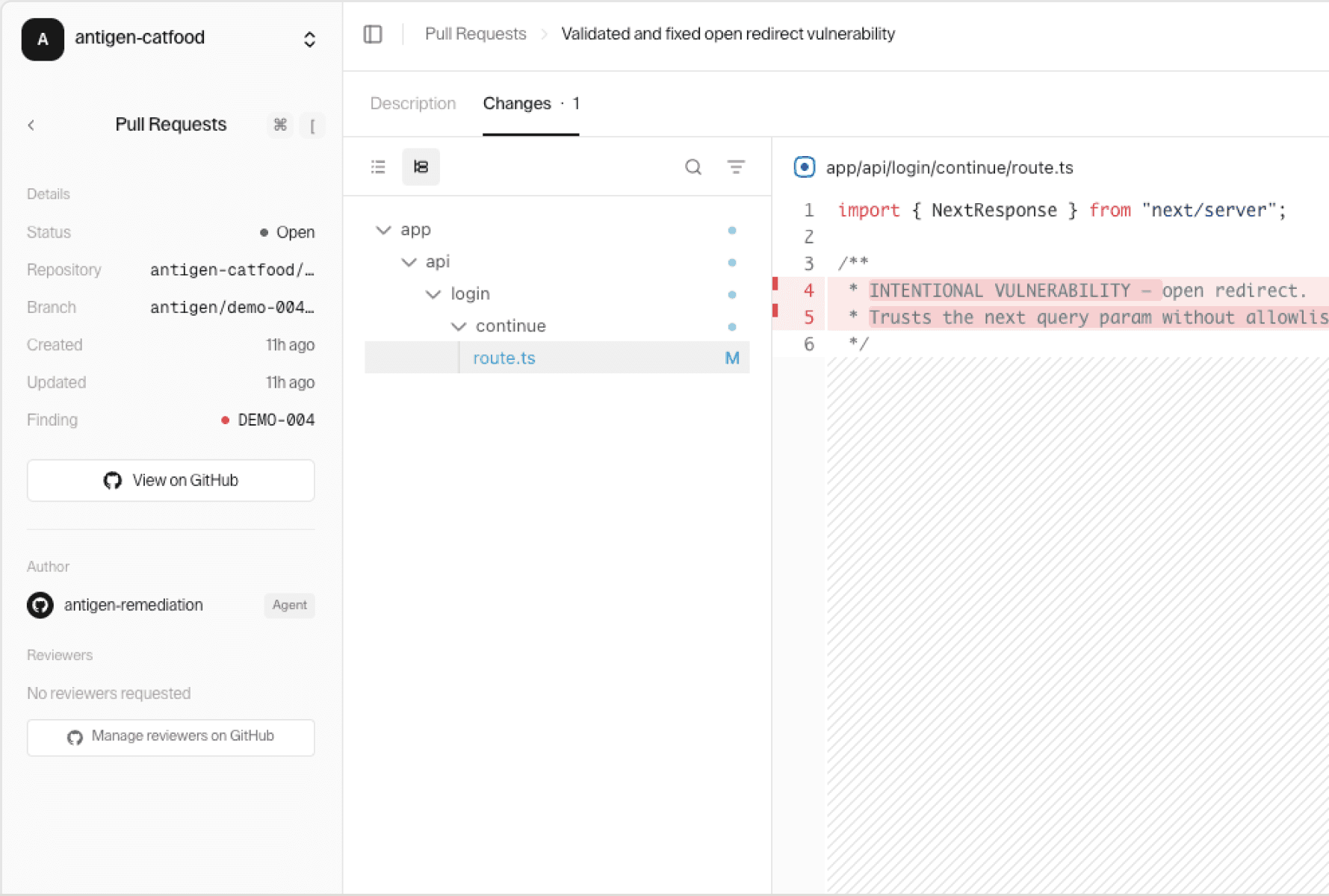
Antigen writes the fix, opens a pull request with the patch, and updates your project management tool. But nothing merges on its own: the PR routes to your engineers, who review and approve before anything reaches production.

Integrates with

GitHub and Linear

03.

Verification by pentest

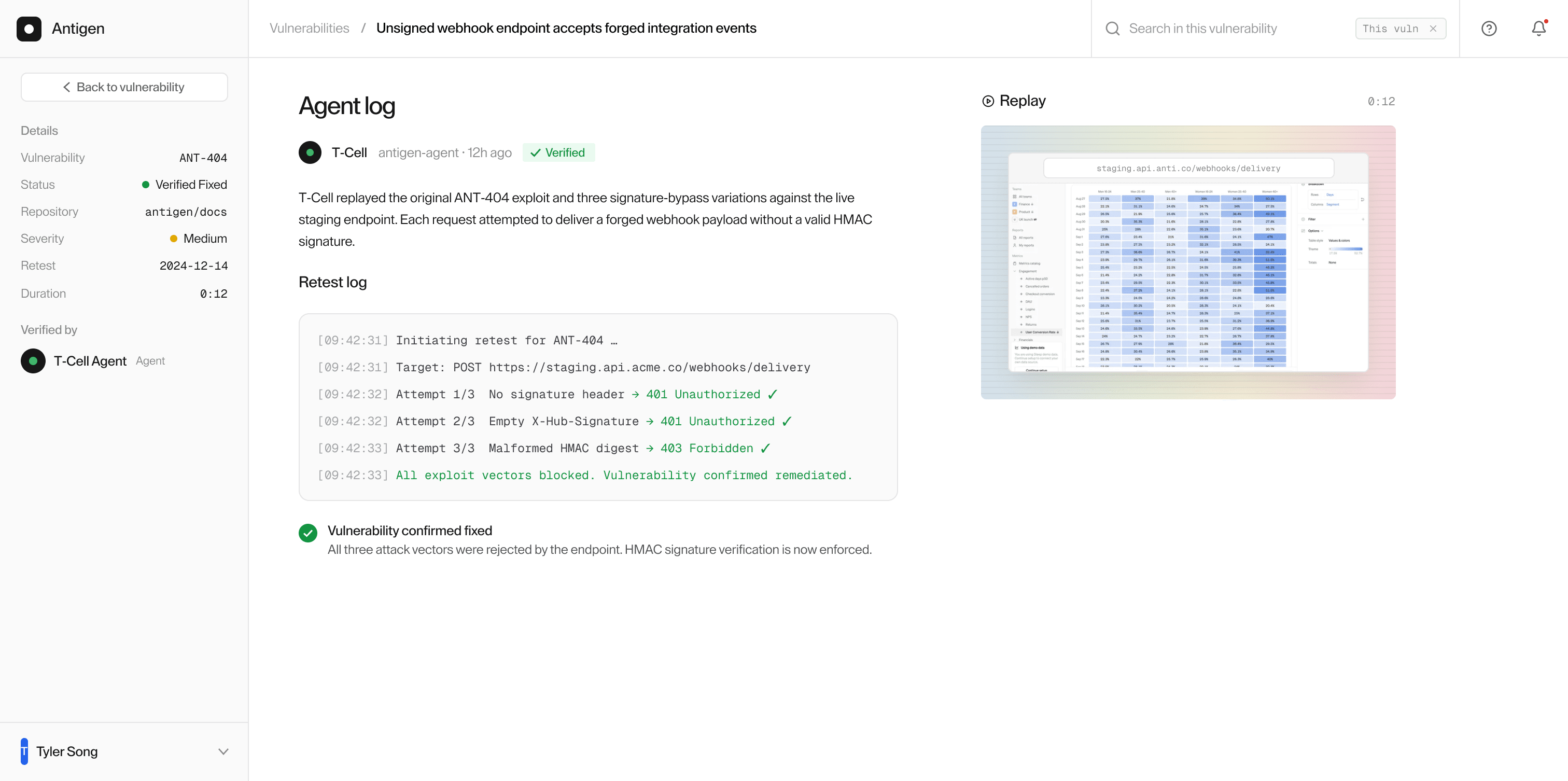
tCell reattempts the exploit to verify the fix

In security, fixing a vulnerability often surfaces a deeper, underlying problem. Antigen runs in a loop, so after deploying the fix, tCell reattempts the exploit. If new issues are surfaced, it reopens the vulnerability with detailed logs, and writes a new patch using what it learned.

Experts in the loop

Each customer gets a dedicated security expert.

In the platform with youA researcher works inside Antigen alongside your team.

Unsigned webhook endpoint ...

Hi Tyler, how can I help?

Abdullah Nauman

Your dedicated expert

Book office hours anytime.

Our researchers will hop on a call, walk your team through a finding, or think through your setup with you.

Every report is reviewed by a researcher before it reaches you.

Your expert reviews every vulnerability to prevent false positives, so your engineering team can focus on the vulnerabilities that really matter.

Infrastructure Graph

Connect your infrastructure and Antigen assembles a live map of everything you expose.

Integrates with

Built for companies where security is trust

For teams that answer to auditors, regulators, and customers.

Different ways to deploy.

Run Antigen managed with zero data retention, or self-hosted entirely inside your network.

Managed

  • Isolated infrastructure managed by Antigen
  • Enterprise-compliant data retention
  • Governed by policy controls you set
  • Run your first pentest in under 30 minutes.
  • Fastest way to start
Learn more

Dedicated

  • Self-hosted Antigen workers run inside your environment
  • Every finding, log, and artifact stays on your systems
  • Runs in your private network
  • Deploys directly on AWS, Azure, GCP, or Kubernetes.
  • For teams whose policies require data to never leave
Learn more

Integrates with your enterprise stack

Antigen works with your logging, identity management, governance controls, and CI/CD

Antigen for Enterprise

Data Retention Policies

Manage data retention with granular controls to ensure provenance and compliance.

Explore retention controls

Audit Trails

Every run, finding, and access event is logged and exportable.

Review audit trails

SAML/IdP

Single sign-on through your existing identity provider.

Configure enterprise SSO

tCell API & SDK

Empower your team with custom internal tools, or run from Buildkite, Jenkins, GitHub CI/CD.

Read the documentation

Book a 30m demo

See a live pentest run against your own infrastructure.

Get a demo